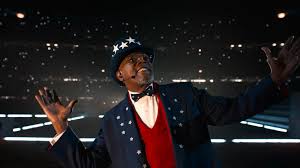
The spotlight was on, and Kendrick Lamar was ready to shine at Super Bowl LIX. A Black man, raised in Compton, on a stage that symbolizes the peak of American achievement—our very own “Great American Game.” But what happened when the curtain lifted and Lamar appeared at the pinnacle of mainstream culture? What he offered us in his performance was not simply a stage show, but a masterful critique of the America that often fails to truly see Black art for what it is, while simultaneously rejecting its complexity.
To understand Kendrick’s Super Bowl performance, we must first look through the lens of W.E.B. Du Bois’ concept of Double Consciousness. This idea suggests that Black Americans are constantly navigating two conflicting identities: the one they see when they look in the mirror, and the one forced upon them by a predominantly white society. Du Bois wrote that we live “with two warring ideals in one dark body,” caught between a desire for self-expression and the demands of a society that seeks to define us on its terms.
In Kendrick’s performance, he is not merely rapping for entertainment. He’s making a statement. He is Black in front of millions of viewers, and yet he is forced to negotiate how he presents himself. This tension comes to life through a creative performance of “Uncle Sam,” portrayed by none other than the great Samuel L. Jackson, who embodies the American cultural archetype tasked with policing Black identity and Black art. Uncle Sam is not just a symbol; he’s a literal figure who is charged with controlling Black expression in a way that makes it palatable to the white mainstream.
The performance becomes a dialogue between Kendrick Lamar and Uncle Sam. And we, the audience, are left to ponder: what are the limits on Black authenticity in a world that still tries to reframe and reshape it for white comfort? Uncle Sam represents the forces of white America, those who seek to define Black art through weaponizing language such as ghetto, loud, and reckless. These words are white daggers against Black culture, stripping it of its richness, nuance, and purpose, all to reduce Black culture to mere “disruption.” Shameful.
Enters Kendrick Lamar, fully aware of these buzzwords and with a brilliant response. He taps into the very symbols of white criticism that have often been used to delegitimize Black expression. Whitelash is embedded into the cultural dialogue surrounding Black performances at mainstream events. Kendrick doesn’t ignore these stereotypes; he engages with them, plays with them, and uses them to his advantage. He takes the power of white critique and turns it into his own weapon, challenging the audience to reframe their understanding of what it means to be “Black” on a national stage. He’s not “ghetto.” He’s Black. And there’s a crucial difference there.
“Whitelash” was bound to come. And while the media and mainstream critics may attempt to devalue the performance, calling it hard to understand or too loud, Kendrick and his team had already anticipated this. They took their message ahead of the conversation and placed the power back into their own hands, rather than allowing others to define the terms.
We saw in Kendrick’s show not only his signature artistry but also an embrace of martial arts culture—a nod to his own interests and the uniqueness of Black culture. Martial arts moves peppered throughout the performance told the story of a man fighting his way through the expectations placed upon him, not just as a rapper, but as a Black man in America. But when Kendrick delivers these complicated, layered messages, all white America saw was a “rapper” who was “too hard to understand.” They were quick to dismiss what they refuse to take the time to understand, just as they often do with Black art in general.
Yet, in that moment, Black people got it. We understood Kendrick’s message, his movement, his rhythm. We saw the beauty in the layers of Black culture that Kendrick, in his unrelenting genius, presented with such precision. White America might not always understand the depth of Kendrick’s words, but Black America does, and that’s where the power lies.
This Super Bowl performance was revolutionary. Not only did it offer a rare, unapologetic glimpse into Black culture on the world’s biggest stage, but it also reflected the kind of nuanced, layered commentary that only a Black artist like Kendrick Lamar could offer. It was revolutionary in its boldness, in its fearless questioning of the rules, and in its quiet defiance. This was not just another halftime show. It was an unfiltered declaration of Blackness in all its forms, complexities, and contradictions.
Congratulations to Kendrick Lamar and his team. The performance wasn’t just a spectacle; it was a movement. It was one of the most profoundly Black performances to ever air on television—an unapologetic celebration of Black art that never once cowered before white America’s gaze. Kendrick Lamar continues to make us proud, taking us on a journey that transcends music and enters the realm of cultural revolution.
Author’s Bio

Latrice Burks-Palmerio, also known by her powerful online presence as #blkgrlmgclwyr, is an expert in American politics with a deep focus on the intersection of American fascism and the decline of empire. Latrice’s academic journey began with an International Baccalaureate class on totalitarian regimes, which laid the foundation for her nuanced understanding of authoritarianism. She graduated with honors in Political Science from the College of Wooster, where her thesis examined the dynamics of Black social movements in the U.S. Further refining her expertise, Latrice earned her law degree from USC Gould School of Law, gaining invaluable insights into U.S. Constitutional law.
As an impact litigator specializing in employment law for marginalized communities and representing survivors of sex crimes, Latrice combines her legal acumen with a deep commitment to justice. She has also contributed to the public discourse through self-published articles that analyze and critique the evolving political landscape of America. Latrice’s work examines how the structures of American fascism and empire-building manifest in law, policy, and social movements, making her a critical voice in understanding the political currents shaping the nation today.


 #blkgrlmgclwyr - blog
Leave a comment